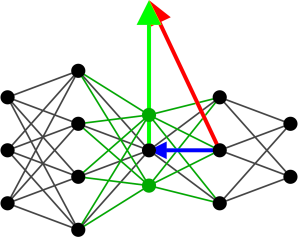
Extension initialization#
When a layer of neurons is grown, new incoming and outgoing connections are
created via
create_layer_extensions().
The method accepts an output_extension_init and an input_extension_init
argument that control how the new weight tensors are filled.
The execution order inside create_layer_extensions is:
Rescaling – existing weights are rescaled in-place (see Variance-transfer initialization).
Extension creation – physical extension layers are allocated.
Initialisation – extension weights are initialised (this section).
Neuron pairing – extensions are doubled via \((V,V)/(Z,-Z)\) (see Variance-transfer initialization).
Available initialization methods#
Each initialization method is a callable with the signature
(tensor, reference_tensor, fan_in) where tensor is the weight (or bias)
to initialize, reference_tensor is the existing weight (or bias) of the base
layer, and fan_in is the fan-in of the layer after including the extension.
"kaiming"#
Standard Kaiming uniform initialization. Samples from
where \(\text{fan_in}\) is the total fan-in of the layer (base + extension).
This is the PyTorch default (torch.nn.init.kaiming_uniform_ with
\(a=0\)) and ensures \(\operatorname{Var}[W] = 2/\text{fan_in}\).
"copy_uniform"#
Samples from a uniform distribution whose bounds are derived from the empirical standard deviation of the existing weights:
where \(\sigma_{W} = \operatorname{std}(W_{\text{ref}})\) is computed over
all elements of reference_tensor.
The resulting distribution has variance \(\sigma_{W}^{2}\), matching the
existing weight distribution.
This is the default initialization in create_layer_extensions. It is
particularly useful when the existing weights have drifted from the Kaiming
scale during training: copy_uniform initializes the extension in the same
statistical regime as the existing weights, avoiding a sudden variance
mismatch in the merged layer.
Fallback: when the reference tensor is None, has fewer than 2 elements,
or has zero variance (e.g. all weights identical), copy_uniform falls back
to kaiming initialization.
"zeros"#
Fills the extension with zeros (torch.nn.init.zeros_). Useful for
debugging or when the extension should have no initial contribution.
Comparison#
Method |
Variance of new weights |
When to use |
|---|---|---|
|
\(2/\text{fan_in}\) (theoretical Kaiming) |
Fresh or well-scaled weights; standard baseline |
|
\(\operatorname{Var}[W_{\text{existing}}]\) (empirical) |
After training when weights have drifted from Kaiming scale |
|
0 |
Debugging, or combined with neuron pairing |
Interaction with variance-transfer rescaling#
When a rescaling strategy is active (see Variance-transfer initialization), the
existing weights are rescaled before the extension is initialized. This
ordering matters for copy_uniform: the reference variance
\(\sigma_{W}^{2}\) is read from the already-rescaled weights, so the new
extension matches the post-rescaling regime.
For kaiming initialization this ordering has no effect, since the bounds
depend only on fan_in.
Adding custom initialization methods#
New methods can be registered by adding an entry to the known_inits
dictionary inside create_layer_extensions. The callable must accept three
positional arguments:
def my_init(
    tensor: torch.Tensor,
    reference_tensor: torch.Tensor | None,
    fan_in: int,
) -> None:
    ...
The callable may also modify reference_tensor in-place if needed (e.g. to
perturb existing weights at the same time).